
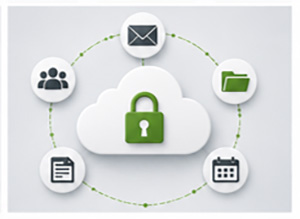
 Microsoft 365 has become the foundation of daily business operations for many financial firms. Email, calendars, file sharing, document collaboration, Microsoft Teams, and cloud storage all live within a single platform that allows employees to work from virtually anywhere.
For financial advisors, wealth management firms, CPA practices, and insurance agencies, that flexibility has transformed how work gets done. Teams can collaborate more efficiently, serve clients remotely, and securely access information without relying on a traditional office network.
Yet one question continues to surface during technology conversations.
Is Microsoft 365 secure enough for a business that handles sensitive financial information?
The answer is yes, but only if it's configured and managed correctly.
Microsoft provides an exceptionally secure platform. However, many organizations assume the default settings are sufficient. In reality, Microsoft 365 is designed to support millions of businesses with different needs, which means many of its strongest security features require thoughtful planning and ongoing management.
The platform itself is highly capable. The way it's configured ultimately determines how well it protects your business.
Security Is a Shared Responsibility
One of the biggest misconceptions surrounding Microsoft 365 is that moving to the cloud transfers all security responsibility to Microsoft.
It doesn't.
Microsoft is responsible for securing the infrastructure that runs the platform. Your organization remains responsible for protecting user accounts, managing access, configuring security policies, safeguarding business data, and training employees to recognize cyber threats.
This shared responsibility model surprises many business owners.
Moving to the cloud eliminates much of the hardware maintenance that organizations once managed internally, but it doesn't eliminate the need for good cybersecurity practices.
Strong security still depends on thoughtful planning, ongoing monitoring, and informed leadership.
Identity Has Become the New Security Perimeter
Years ago, organizations focused primarily on protecting their office network.
Today, employees work from homes, client offices, airports, and mobile devices. Cloud applications have replaced many traditional servers, making user identities far more important than physical office walls.
That shift makes identity protection one of the most critical components of Microsoft 365 security.
Strong passwords alone are no longer enough.
Multi-factor authentication, conditional access policies, secure administrative accounts, and careful user access management all work together to protect business systems from unauthorized access.
For many financial firms, strengthening identity security provides one of the most significant improvements they can make with relatively little disruption to daily operations.
Email Continues to Be the Primary Target
Most successful cyberattacks still begin with email.
Phishing campaigns, fraudulent invoices, business email compromise, and credential theft all rely on convincing employees to trust something they shouldn't.
Because Microsoft 365 serves as the primary communication platform for so many organizations, securing email deserves ongoing attention.
Modern email protection extends well beyond spam filtering.
Organizations should evaluate advanced phishing protection, malicious attachment detection, impersonation protection, email authentication standards, and employee security awareness training as part of a comprehensive strategy.
Technology helps identify threats.
Educated employees provide an equally important layer of defense.
Collaboration Creates New Opportunities and New Risks
Microsoft 365 makes collaboration remarkably easy.
Employees can share documents, communicate through Teams, collaborate in real time, and access information from virtually anywhere.
Those capabilities improve productivity, but they also require thoughtful governance.
Who can share files externally?
How long should information be retained?
Which employees have administrative privileges?
Are former employees removed immediately after leaving the organization?
Answering these questions helps organizations balance convenience with appropriate security.
The goal isn't restricting productivity.
It's ensuring collaboration happens safely.
Security Requires Ongoing Attention
Cybersecurity isn't something organizations configure once and forget.
Microsoft regularly introduces new features, improves existing security capabilities, and responds to evolving threats. At the same time, businesses hire new employees, adopt additional applications, and expand how they use cloud services.
Those changes create new opportunities to strengthen security while also introducing new risks if environments aren't reviewed regularly.
Routine security assessments, periodic permission reviews, employee training, and proactive technology planning help ensure Microsoft 365 continues supporting the business safely as it evolves.
The most secure organizations don't simply purchase technology.
They continuously improve how they use it.
How Linear 1 Technologies Helps Financial Firms
At Linear 1 Technologies, we help financial advisors, wealth management firms, CPA firms, and insurance agencies get more value from Microsoft 365 while strengthening the security of the entire environment.
Our approach goes beyond basic administration.
We help clients secure user identities, improve Microsoft 365 configurations, protect email communications, strengthen collaboration policies, and align technology with broader cybersecurity and business objectives.
The result is a Microsoft 365 environment that supports productivity without sacrificing security.
One Question Worth Asking
If someone successfully obtained an employee's Microsoft 365 password this afternoon, how confident are you that your organization could stop them from accessing sensitive client information?
For many businesses, that simple question reveals where future technology investments should begin.
Cybersecurity isn't about assuming an attack will never happen.
It's about building systems that remain resilient when someone eventually tries.
Frequently Asked Questions
Is Microsoft 365 secure enough for financial advisors, CPA firms, and insurance agencies?
Yes. Microsoft 365 offers a highly secure platform, but organizations must properly configure and manage security features to fully protect sensitive business and client information.
Does Microsoft automatically protect my business from cyberattacks?
Microsoft secures the cloud infrastructure, but your organization remains responsible for user accounts, access controls, security policies, employee training, and many configuration decisions that directly affect your cybersecurity posture.
Is multi-factor authentication enough to secure Microsoft 365?
Multi-factor authentication is one of the most important security controls available, but it should be part of a broader strategy that includes identity management, email security, endpoint protection, regular monitoring, and employee cybersecurity awareness.
Should Microsoft 365 settings be reviewed regularly?
Absolutely. Microsoft continually updates its platform, and businesses evolve over time. Regular reviews help ensure security settings, permissions, and policies continue to align with your organization's needs.
Can a managed IT provider improve Microsoft 365 security?
Yes. An experienced managed IT provider can optimize Microsoft 365 security configurations, monitor the environment, strengthen identity protection, improve email security, and help ensure the platform supports your firm's broader cybersecurity strategy.